John Tavener’s final work, Krishna, might never have seen the light of day, were it not for his widow, Maryanna, and King Charles, no less, persuading director Sir David Pountney to take up the cause. Pountney got Wasfi Kani, founder of Grange Park Opera, on board, and here we are. However, one came away from this laudable attempts wondering whether Tavener’s memory has been ultimately serviced by staging this fundamentally flawed piece. Tavener described Krishna, as a “mystical pantomime’” and, rather than a single clear narrative, it depicts 13 scenes from the life of Krishna, bookended by a prologue and epilogue. Krishna is portrayed by four singers to represent different phases of his life – child, adolescent, young man and adult man.

Tavener’s music is mostly episodic, with short sections repeated or alternated in chains with pauses between. This is relatively successful in places, with a kind of meditative build in tension, although we are kept waiting for a fair while before any sense of climax. And herein lies the staging challenge. How do you stage repetitive, meditative musical tableaux, with relatively little dramatic action? What do you do with live singers on stage, if they are not going to just stand and deliver the music?


So in the ‘ecstatic’ love duet between Krishna and Radha, they endlessly sing each other’s names, as the music cycles and repeats. But they soon run out of positions – so to speak – either side of the stage, meeting in the middle, back to sides lying down, up the stairs at the side of the temple set. They eventually disappear at the top of the steps, presumably for some kind of cosmic consummation, only to return for another round on the stage. The same problem returns at the end of work, with the four Krishnas singing some of the most beautiful music, interspersed with a Mozart quotation (from his tenth Piano Sonata – why?) but four times, moving slowly from the stage up the steps before finally disappearing. We see where this is going, and so any sense of drama is lost.

There is a single set, with a central tiered temple, in which the chorus sit in rows pretty much throughout, two side platforms and three large drums, used to impressive effect by drummer Nao Masuda. Rachana Jadhav’s design of the temple staging, combines with effective lighting from Tim Mitchell do create a colourful and pleasing backdrop to the ‘action’, as do the vibrant costumes. The troop of six dancers, choreographed by Shobana Jeyasingh, provide attractive movement, in some ways more suited to the figurative music than the more literal characters on stage.
One dramatic addition in the second half is a huge inflatable red serpent, its impact rather undermined by its defeat reminding one of the torture of trying to get an inflatable mattress back into the box, the only sense of jeopardy being would they manage it before the scene ended. The chorus sang from their seats, and occasionally got to brandish random paper cut-outs, as well as give Mexican waves to accompany the flutes in the balcony (again, not sure why). But their singing, and occasional chattering through megaphones was nevertheless confident and assured. Some of them also got to come down onto the stage for some writhing to portray jumping onto the absent funeral pyre.


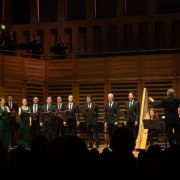
Darkly authoritative baritone Ross Ramgobin introduced each tableau with a description of the scene, which told us all we needed to know, so once again minimising the drama. All four Krishnas played their parts with conviction, moving from Rosa Sparks’ bright as a bell soprano (child), to Eliran Kadussi’s mischievous yet lyrical countertenor (adolescent), his scenes with Jennifer Statham as the young Radha both playful and convincing. Tenor Elgan Llŷr Thomas had the most significant role as young Krishna, one which he delivered with strong tone, as did bass Brett Polegato as adult Krishna.

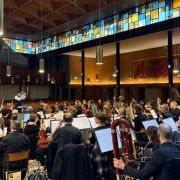
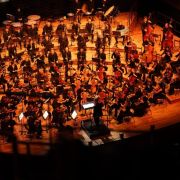
Sopranos Julia Sitkovetsky (Radha) and Nazan Fikret (Rukmini) stood out as the most impressive voices of the evening, their ‘uniting’ duet almost eclipsing the love duet between Radha and Krishna. Tavener stretches them to extremes, with widely spaced clashing intervals, resolving into each other then back to either end of their range, both singers nailing the pitches with assurance. Similar challenges were given to Sitkovetsky and Thomas, the young Krishna, by and large securely executed, although the extended nature of their duet led to the odd sign of fatigue towards the end. Mark Shanahan conducted the Gascoigne Orchestra with controlled precision, and moments of glistening brass and bells brought the score to life, as did the ‘aerial’ flutes up in the high balcony.
An unpublished work of a deceased composer must always be a great temptation, but on this occasion, sadly, it might have been best left alone.