Puccini’s La bohème is perhaps the world’s best loved Italian opera. But no need to scour the international listings for it, where you will find many productions; make your way to the Royal Opera House, Covent Garden to see as complete a performance as you are likely to encounter anywhere. The much-revived 2017 production by Richard Jones still stands up well and has been intelligently honed by revival director Simon Iorio.

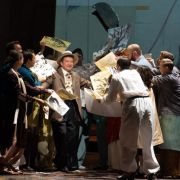
The garret set of Acts 1 and 4 still has a long ladder through its roof, surely a bad idea given the residents’ complaints about how cold their attic dwelling is. It’s only there so that Rodolfo can look over the roofline of Paris and comment on the “thousand smoking chimneys” in his opening lines. The libretto’s requirement for a large window at the rear to show that view should have prevailed. Act 2 with its seamless changes from Paris arcades, to Café Momus, to street-lit procession of a trumpet-led marching band, is highly impressive still, as are the brilliant costumes for adults and children who are Christmas Eve shopping in their finery. The bare set for Act 3 lacks a discernible barrier for Paris’s Barrière d’Enfer, and the dingy tavern looks far from cosy. These settings have had mixed reviews on this site, but they never impair the drama.


This is a tragi-comic work – Mimi’s tragedy is one strand only in the tale of a gregarious quartet of young males, three artists and one philosopher. None is able to make much of a living from their art, and they are too poor to pay their rent (for an attic shared by four?). But poverty never entirely eradicates poetry or camaraderie in this vie de bohème. The quartet sing and act well together, enjoying their jokes burning Rodolfo’s play-text, too brief to provide warmth, and humiliating their boastfully libidinous landlord.

Freddie De Tommaso has added heft to his voice at the expense of some sweetness, but he still makes a winning Rodolfo. In Che gelida manina he warmed Mimi’s hands and audience hearts. Mimi’s response was better still, from Armenian soprano Juliana Grigoryan, who debuted at the house this season, as Liù in Turandot. Hers is as warm and attractive a voice as one could wish to hear as Mimi, and she sang with all the poignancy the role demands. If there was a small flaw, it was the not uncommon neglect of some initial consonants. Thus her “Addio, (s)enza rancor” had no sibilance reaching row K. But it was still touching, and hardly a major fault, so let us move on, senza rancor. Her future visits to Covent Garden I hope will be soon and often, despite recent offers in her bio from Milan and the Met.

Musetta was Marina Monzó, a house debutant and another we should welcome back. A scarlet woman in a scarlet dress, its skirt wide enough to make it easy when standing on a table in the crowded Café Momus to reach beneath and remove an item of under clothing to drop on the head of Marcello, who was ignoring her – well, until then. Travellers to Paris should seek out the Café Momus (a real place) or its successor, to learn if the atmosphere is unchanged. The Marcello of Luca Micheletti was a worthy adversary in love, and when he threw her out bag and baggage, and calls her a Strega! – a witch – it was because he is bewitched. The benefits of his training, as an actor as well as singer, were evident. His Act 4 duet with Rodolfo, one of the score’s more delicious plums, was handicapped by setting the duettists wide asunder, at the extreme edges of the garret where they were furthered inconvenienced by each singing in the narrow space between wall and supporting roofbeam. They still managed to deliver vocally and gain a cheer – as did almost every item in this score. Colline, portrayed by Italian bass Gianluca Burrato, sang a tender farewell to his overcoat ("Vecchia zimarra") as well he might, as the only impoverished Bohemian who owned such a bourgeois garment.


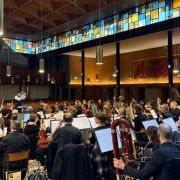
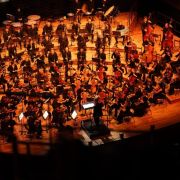
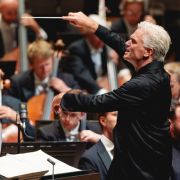
Lorenzo Passerini conducted with verve and lyrical intensity as needed, and observed the various instructions for more languor with taste and judgement. He even attempted the ppppppp (yes, seven p’s!) at the moment of Mimi’s passing. It was breath-taking: a fragile thread of tone, like the fragile thread of life about to be broken. Puccini even scribbled a skull-and-crossbones in the score at that point, then, he tells us, stood up and wept, as many have wept since.