Poor Samson. It’s not enough that the Philistines lop off those luscious locks, integral to the kind of strength that will probably see him making an appearance in a future superhero franchise – they then go one step further and blind our once hirsute hero! Mind you, it’s probably a blessing in disguise for Samson as it saves him from further subjection to the rather strange vision of Samson et Dalila that Richard Jones conceived, returning to Covent Garden following its 2022 debut.

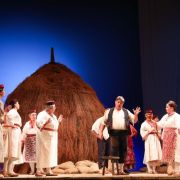
Jones is a talented director who often provokes thought, but this production of Saint-Saëns’ masterpiece is hard to love and represents the kind of opera that leaves regular punters fulminating without offering anything to draw in an alternative crowd. The set is largely bare, pace a giant blue gambling icon that turns up (briefly, thank heavens) in Act 3. This is Dagon, we assume, and given that the Philistines here are dressed in a variety of glittering garish costumes, one could make a case for Samson as a Gordon Brown-esque campaigner against the gambling industry. Confusingly, the Philistine men are dressed in banana republic commando gear in Acts 1 and 2.


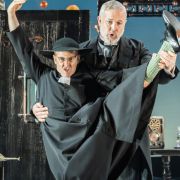
Concept gripes aside, the production also fails in a lack of consistent Personenregie in its principals: Samson himself is presented as one of those slightly earnest young believers who would try to convert you on the bus and definitely eschews pornography. Dalila is motivated by loss to seduce and betray Samson – but apparently feels uncomfortable doing so. We are not given more than that. The strongest is in Samson’s Rabbi, who is presented to us as a religious leader who sees in Samson both the salvation of his people and a surrogate son. The behaviour is plausible, the direction regular, the execution strong.

It could be a question of chemistry that hinders this revival from sizzling. Dalila is a role debut for Aigul Akhmetshina and while it is natural that she does not yet own the role in the way that she does Carmen, there are similarities of approach: an attempt to layer psychological depth, that sense of ‘the other’ and her approach to seduction. The trademarks of her voice – that smokiness at the lower reaches of the voice, the crystalline purity at the top – were on full display and, as is so often the case with Akhmetshina, she held the stage naturally. The principal issue of chemistry arose in that where she was sinuously alluring, tenor SeokJong Baek was stolid, with little hint of lust. His tenor is easy on the ear, with a warm orange tone ideal for those rich French phrases, but in Act 1 he failed to offer a convincing portrayal of a motivational leader, and in Act 2 that sense of lust was absent.


In the role of Samson’s Rabbi, William Thomas delivered the best performance I have seen from him; his bass powered across the house, showing a sense of line and a fine range. As the High Priest of Dagon, bass-baritone Łukasz Goliński was directed as somewhat of a caricature, virtually needing a moustache to twirl, but vocally, he was on good form, injecting malice and bark into his singing – a characterful performance.

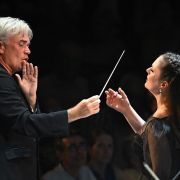
Saint-Saëns’ choral writing is one of the highlights of the work and the ROH Chorus was in tremendous voice, particularly in the “Hymne de joie”. In the pit, Alexander Soddy conducted the orchestra in a performance that was, at times, somewhat shy; while never overwhelming his singers, there were times when a little more thrust would have lifted the production. Overall, a mixed evening, but with coups and counter-coups, an appropriate opera to see in the current political climes!