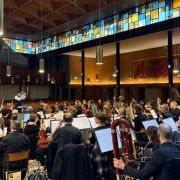
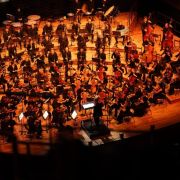
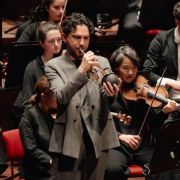
A very American flavour greeted Amsterdammers for the Concertgebouw’s season opener as their newly appointed composer-in-residence, Black American composer Carlos Simon, and the Pittsburgh Symphony Orchestra under their Chief Conductor Manfred Honeck channelled the party atmosphere. Neighing trumpets, syncopated percussion claps, jazz violin improvisations and a bangin’ black metal pole – just some of the delights meted out in Simon’s Four Black American Dances which depict everything from ‘a dance of enslaved Africans’ to a 1930s debutante ball and the exuberance of an evangelical church service. On their feet, raucous, braying trombones depicted worshippers hoisting their hands in the air, while deliberately corny clichés found the party in full swing.


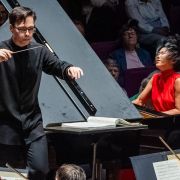
Continuing the American theme, Pittsburgh’s portrait artist, Augustin Hadelich carefully descended those famous stairs for Samuel Barber’s Violin Concerto. A collaboration previously witnessed in June on their home turf, Heinz Hall, a venue whose red carpet bears striking similarity to that in the Concertgebouw. From the outset, Hadelich’s crystal-clear tone variously moulded Barber’s sumptuous melodies – faster vibrato here, a cheeky harmonic there. In response, the orchestra's sophisticated accompaniment proffered a sensitive cushion. Never overpowering, simply seeking to amplify his will.
His performance felt personal. As the mood turned mournful, and sublime oboe strains transported in the Andante. Hadelich’s violin tugged at every fibre of our being with playing of such intensity and emotional sincerity in melodies high up the G string, that my heart melted. His playing was so profound; it felt like a moment in time. Segueing immediately into a mesmerising moto perpetuo, his technical display dazzled.

Hadelich, though, is a gift that keeps on giving. Instead of his oft favoured virtuoso American-inspired arrangements, he had saved the best until last. His own arrangement of Schumann’s Träumerei, complete with double-stopped (artificial) harmonics. Simply divine.


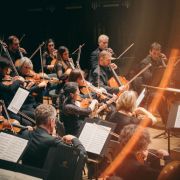
If the first half had reduced this concertgoer to an emotional wreck, what followed in Dvořák’s Ninth Symphony “From the New World” was absolutely joyous. The sheer musicality of each and every musician on stage was staggering. Surging trumpets, ecstatic hunting horns, translucent flutes and a tender cor anglais all played their part.

Conducting from memory, Honeck calmly reduced proceedings to a whisper. Rarely does an orchestra lay emotions so bare as in the Andante’s closing lament when solo violin and cello invited a warm double bass riposte; or when delicate clarinet and flute trills and the gentlest of triangle strokes teased every sinew of Dvořák’s realm.
The evening ended as it had begun with a party atmosphere and Brahms’ Hungarian Dance no. 1 in G minor.