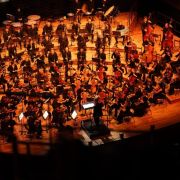
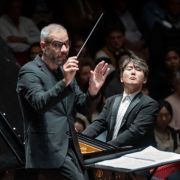
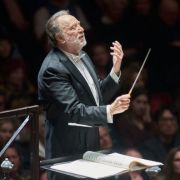
For their third appearance at the Concertgebouw under Klaus Mäkelä, the Orchestre de Paris chose two dramatic works: Rachmaninov’s Second Piano Concerto and César Franck’s less frequently performed Symphony in D minor, two masterpieces that proved apt to highlight the orchestra's flexibility, dramatic force and transparency. The pianist was the talented Anna Vinnitskaya.

The story of Rachmaninov’s concerto is well known: after the disastrous premiere of his First Symphony, he fell into a deep depression and all but stopped composing. His return came after a course of treatment with the physician Nikolai Dahl, who helped him regain his creative forces. The Second Piano Concerto was a direct fruit of this recovery and bore a dedication to Dahl. Yet it was not the story of a man slowly nursed back to life that Vinnitskaya seemed to be telling us. Her approach had a more dramatic, resolute dimension, that of a tragic hero determined to confront any adversity at whatever cost.


She opened the work with muscular chords, finely arched in an expressive crescendo. When the piano broke through in its arpeggios, the orchestra blended in seamlessly, as if it had been there all along. Vinnitskaya possesses a solid virtuosity, but her ease at the keyboard never understated the tragic appeal of Rachmaninov's writing. There was immense depth in the dialogical exchange between soloist and orchestra, which reached moments of genuine chamber-music intimacy in the second movement, where Vinnitskaya and the Parisian woodwinds merged in unhurried warmth. Their attention to the contrapuntal nature of the material throughout the concerto did not for a second make it sound cerebral. On the contrary, there was such passion from both soloist and orchestra that by the time the work reached its final pages, the ensemble seemed ablaze in a game of refracted light. Her martellato had diamond-cut precision and matched the orchestra with perfection before the signature chords that close the work. To warm applause, she returned onstage with a Rachmaninov's Étude-tableau as an encore.
If Rachmaninov's concerto follows a more linear trajectory from conflict to resolution, the same cannot be said of Franck's Symphony and its cyclic enterprise. Mäkelä and the orchestra seemed determined to bring out the work's inner ambiguities, deploying a potent, smoky sonority in favour of an emotionally charged reading. The introduction sounded like an ontological question of divine proportions, with Mäkelä keeping the phrases spacious and mysterious. The exposition arrived in fast attack and full contrast, with the orchestra diving fully into each modulation. The F major theme appeared with a noble attitude, the horns and woodwinds here were wonderful, their conviction enough to melt one's heart.


Solitude pervaded the second movement through the cor anglais, the harp glowing softly beneath the strings. In the Scherzo section, the pulse remained steady, and the mood gained dubious, almost sensuous contours. When the cor anglais and the Scherzo themes were superimposed, the effect was powerful, as if the orchestra were painting an ancient scene with the colours of memory. In the jubilant finale, material from the previous movements returns, and the orchestra placed them back on stage so convincingly that what one heard was less the cyclic structure of the work and more the echo of a pain overcome. Franck, much like late Beethoven (from whom he borrows an idea for the introduction), seemed to know that pain is contained within triumph. The result, crowned by a luminous crescendo of extraordinary breadth, was a sonorous glass cathedral.