Every joke needs a punchline. It took five years for Richard Strauss and his librettist Hugo Von Hofmannsthal to come up with the final version of their self-referential opera in which high and low culture collide in a very Viennese in-joke, albeit one that satirises the philistinism of aristocratic patronage. But even after all that time they chose an unhelpfully po-faced title and neither could agree on the ending. Fair enough, the context had changed somewhat: the riots of 1911 were confined to the city’s hungry working class. By 1916, war made laughter – like food – difficult to come by unless you were so well upholstered that you could still enjoy the opera, in which case Ariadne auf Naxos would have proved a delightful evening, flattering you as an aficionado while indulging your guiltier pleasures. Light in dark times.

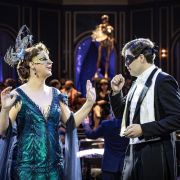
Plus ça change, plus c’est la même chose. And so here we are, picnics akimbo, at Glyndebourne for Laurent Pelly’s new staging of Strauss’ much-loved meta-work that presents opera as a time machine, from Massimo Troncanetti’s fin de siècle Viennese villa and striped cyclorama backdrop to Pelly’s playful riffs on pop culture from pierrots to Weimar cabaret to Marilyn Monroe. With a stellar cast to boot there’s every reason to hope that a bit of the old Strauss magic will conjure a distraction from hell or handcarts, though there is also some very witty wheelbarrow choreography.


The richest man in Vienna has commissioned an opera on a classical theme plus a commedia troupe for an evening’s entertainment. It can’t be helped when dinner overruns and the artistes – who have already been paid – are tasked with getting through both shows before it’s time for the firework display, which must happen at 9pm or else. The solution, to run them simultaneously, horrifies the opera’s self-absorbed Composer but is all in a day’s work for the troupe’s pragmatic leading lady Zerbinetta, who rightly points out that while Art might expand the soul, a job is a job. The Composer’s latest Gesamtkunstwerk is going to be a bit more gesamt than he’d bargained for.

In this most sophisticated iteration of ‘the play that goes wrong’ genre most of the jokes are in the Prologue – the first half of the performance, the second half of which is ‘The Opera’. The explosive trails of farce are carefully laid as the Major-Domo, played with relish by William Relton, explains the situation. Samantha Hankey’s wonderful performance as the despairing Composer dominated the first half and perfectly captured the challenge at the heart of the piece: how to balance the sublime with the ridiculous. Hankey’s expressive vocal agility was compelling, as was her comic range. When the Composer responded to the Major-Domo’s request for a rapid rewrite with “Something like this was foretold when I was young”, it almost brought the house down. Who hasn’t been warned that a life in art is a life of compromise, if you’re going to eat?

Rachel Willis-Sorensøn’s Prima Donna was all backstage affrontment at the news her Ariadne would not be alone on her desert island and as ‘The Opera’ got underway in the second half, so did Strauss’ epic drop-the-mic battle between the two sopranos. A rocky outcrop, squeezed up against the villa’s front door, dominates, with dark mountains rising comically behind. Alina Wunderlin’s sublime Zerbinetta, on whom Pelly relies for much of the comic heavy lifting, stopped the show with the deliciously complex “Großmächtige Prinzessin”, flossing her way insouciantly through the stratosphere while the Prima Donna wonders how her Ariadne is going to follow that. But follow it she does, and Willis-Sorensøn poured heart, soul and a voice to move the gods into Strauss’ musically epic finale, matched by David Butt Philip on heroic form as Bacchus.


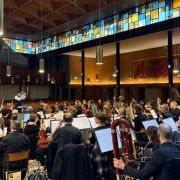
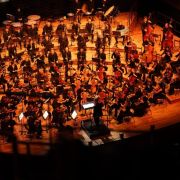
The difficulty for any director is that Strauss’ wild ride of a score is dramaturgically overwhelming. Robin Ticciati perfectly controlled the music’s burnished journey through the 19th century and into the 20th, drawing lush colour and piquant detail from a fully invested London Philharmonic. However, Pelly’s low-level intervention in the denouement of what began as an elaborate joke leaves the audience marooned. It’s a brave man who promises fireworks in this neck of the woods and then doesn’t let them off.