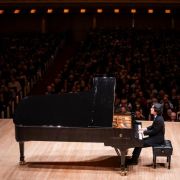
Few recent debuts at Carnegie Hall have been as anticipated as Alexandra Dovgan’s, drawing a full Zankel Hall on Thursday night. Her programme avoided virtuoso rhetoric, tracing how continuity is sustained and transformed from Chopin to Prokofiev.

The first half of the recital was devoted to Chopin. In the Barcarolle in F sharp minor and the Piano Sonata no. 3 in B minor, Dovgan did not treat the music as a sequence of expressive surfaces but as a continuous field in which musical ideas are sustained, tested and reshaped across shifting textures. The Barcarolle moved forward with quiet insistence, its rocking left-hand rhythm clearly articulated so that motion arose from harmonic direction rather than atmosphere, sentiment restrained. Ornamentation was absorbed into the line rather than set apart, each phrase growing out of the last. That same discipline shaped the Sonata, whose large span emerged without exaggeration: the first movement grew from a firm pulse, its contrasts integrated into a single trajectory; the Scherzo’s lightness was grounded in rhythmic control not brilliance; the Largo sustained a long, unbroken line; and the Finale followed as the natural outcome of accumulated momentum.


Later, her three Chopin encores continued the same approach, refining it within smaller forms. The two waltzes avoided charm as an end in itself, their elegance held in check, while the A minor Mazurka turned inward, its asymmetries quietly exposed. In Dovgan’s Chopin, phrasing followed structure, not the other way around.
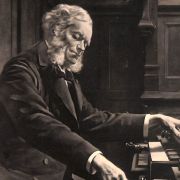
In César Franck’s Prelude, Chorale and Fugue, continuity took shape through recall. Dovgan emphasised the work’s cyclical logic, allowing earlier material to return with altered weight and meaning. The Chorale was shaped with restraint, its simplicity set against the more fluid writing of the Prelude. Widely spaced chords, articulated sequentially, allowed subtle chromatic shifts to register without added weight. In the Fugue, the clarity of voicing remained unshaken even as density increased. The return of the Chorale material registered as transformation, not restatement. With textures at times assuming a pre-Debussian translucency, the pianist’s maturity and independence of thought came most clearly into focus.

With Prokofiev’s Piano Sonata no. 2 in D minor, continuity itself became unstable, though it remained under firm control. Dovgan did not smooth over the work’s contrasts but gave them definition, allowing abrupt shifts to unfold within a consistent trajectory. The first movement’s restless energy was articulated with clarity, its angular gestures integrated into the musical fabric. The Scherzo’s mechanical drive was precise, its motion sustained within a firm pulse, while the slow movement, with its meandering harmonies, avoided excess lyricism, its line maintained without indulgence. In the Finale, the composer’s characteristic sardonic wit, already present in this early work, was clearly audible, the brilliance of the writing present but not brought to the foreground.


Dovgan offered no fewer than six encores. Alongside the Chopin selections, she evoked the late Romantic lyricism of Rachmaninov’s Prelude in G sharp minor, the elegant, slightly archaic charm of Rameau’s Le Rappel des oiseaux and, as a point of arrival, Bach’s chorale Jesu, bleibet meine Freude in Myra Hess’ transcription, its calm sustained with quiet poise.
Across the programme, Dovgan’s playing avoided imposing a single interpretive lens, instead responding to the internal logic of each work. What linked her performances was a consistent attention to how musical ideas unfold over time. Such a structurally grounded and revealing debut from so young a pianist is rare.