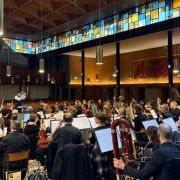
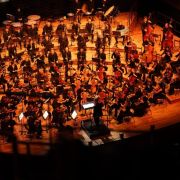
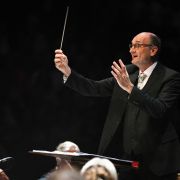
Vladimir Jurowski’s bold London Philharmonic programme united Ukrainian and Russian music into an explosive whole. Sergei Prokofiev and Alexander Mosolov, usually thought of as Russian, were in fact born in in what is now Ukraine. In this concert, only Rachmaninov could claim to be entirely Russian.

The ‘Ukrainian’ composers were represented by scores that were about struggle and violent energy. Mosolov’s The Iron Foundry’ is a three-minute blast of 1920s brutalist noise – thrilling and unnerving in its simplicity – and is the only work by which the composer is remembered. The LPO produced a suitably excessive fortissimo throughout.


This led to a very different Slavic vein, with Rachmaninov’s most charming concertante work, the Rhapsody on a Theme of Paganini. It demands the utmost precision of both the soloist and orchestra to do justice to the intertwined orchestration. Communicative Russian pianist Anna Vinnitskaya and the LPO were impressively conjoined. Vinnitskaya displayed a varied palette of colours, never overplaying the romanticism or charm. She was relatively refined in the big tune at Variation 18, which hit just the right note. Jurowski closely supervised the whole performance, holding back something till the final peroration.
Anna Kosun is a composer and performance artist. Her piece Terricone was commissioned by the Bournemouth Symphony Orchestra in 2023. It was fascinating to hear a work which pushes the orchestra to new possibilities and approaches music as sound beyond the harmonic and melodic. Using a large orchestra, the conventional instruments were rarely used in a conventional way. The percussion section was expanded to include a flexatone, a water phone and more besides. The resulting aural picture seemed to depict nature in all it’s tweeting, scratching, growling and violent clashes. Reminiscent of early avant garde works by Penderecki and others, it made a strong impression on a slightly bemused audience.


Likewise, if you were expecting to hear the Prokofiev of Romeo and Juliet or even the Fifth Symphony you would be shocked to hear the harsh tone of the first movement of his Symphony no. 2 in D minor, written in Paris in 1925. Even Prokofiev didn’t know what to make of the work after the first performance, its tone and meaning seeming too elusive to him. A century on and that impression remains. However, as demonstrated by this gutsy performance, if you just go along for the ride and try not to read too much into it, the result is thrilling.
Jurowski took a full-on approach, grinding through the first movement’s discords without shame and only pulling back in those rare moments where everyone is catching their breath. It felt completely thuggish and authentic. The long variation form second movement has some light and shade, thankfully, giving us glimpses of sunlight and whiffs of charm. Here Jurowski and the orchestra were able to mould the music and try to make sense of its ungainly structure, maintaining a sense of something dark and ominous approaching. This was a strong performance of a symphony that continues to baffle.